 Meshy VS
  Tripo 3D
In short
- Both services offer free access.
Categories Game development, AI 3D models and graphics AI 3D models and graphics
Pricing and payment
Pricing model Trial Trial
Starting price Free Free
Free access Yes Yes
Pricing plans - Free — Free
- Pro — $20 / 1,000 credits
- Premium — $40 / 3,000 credits
- Ultra — $100 / 8,000 credits
- Studio (первый месяц со скидкой 50%, пакет 1X, 1 место) — $35 / 5,500 credits
- Enterprise — Contact for pricing
- Free — Free
- Pro — $20/month
- Max — $90/month
- Team — $132/month
Regional payment options Pay directly on the website Pay directly on the website
Ratings and reviews
Editorial assessment Good specialized service Good specialized service
Functionality Good Good
Price and value Good Good
Ease of use Good Good
Reliability and support Average Average
Innovation Good Good
User rating +2 +1
User reviews 4 —
Average review score 5 out of 5 · rated reviews: 4 —
Data freshness
Service status Online, checked Online, checked
Last full review of the listing
Checked
Values come from catalog data: collected pricing, editorial assessments, reviews and the verification history. How we assess tools
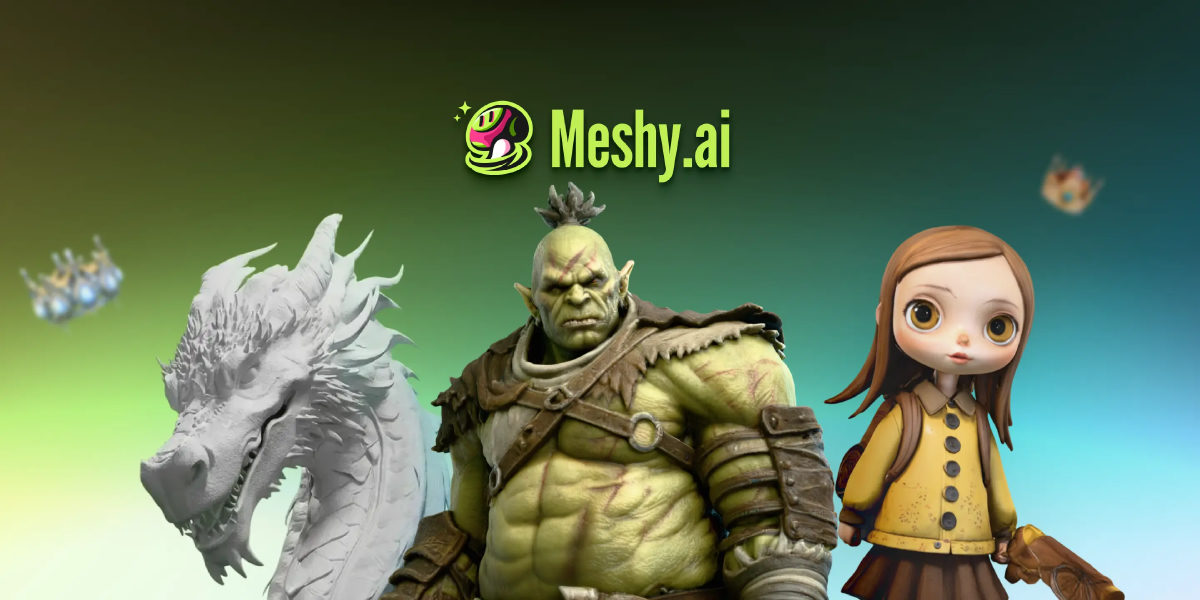 Meshy
Meshy Good specialized service +2 Pros
- Fast mesh generation from single images, multi-view references, or text prompts in under a minute
- Comprehensive PBR map generation (albedo, normal, roughness, metallic) up to 8K
- Built-in auto-rigging for humanoids and quadrupeds with hundreds of motion presets
- Slicer-ready 3D printing prep with watertight geometry validation and auto-splitting
Cons
- Hard-surface objects with precise mechanical edges often come out rounded or softened
- Meshes generated via the standard API are deleted after three days unless on an Enterprise tier
- Complex topological loops often require manual retopology before deformation-heavy production animation
 Tripo 3D
 Good specialized service +1 Pros
- Native quad topology (Smart Mesh) with granular polygon control from 500 to 25,000 polygons
- Automated skeletal auto-rigging for humanoids and creatures with facial blendshape support
- Direct DCC bridges for one-click asset transfer to Blender, ZBrush, Maya, Unreal Engine, and Unity
- Dedicated 3D printing pipeline with manifold geometry generation and bed-sized model segmentation
Cons
- Intricate thin geometries like thin grilles, delicate antennas, or fingers frequently require manual touch-ups
- Single-view image inputs tend to hallucinate unseen rear geometry, requiring multi-view setups for strict accuracy
- Free tier restricts assets to public visibility and non-commercial use with single-task queue processing