
 Pay as you go
GenAPI
Quick facts
- Pricing model
- Pay as you go
- Minimum price
- Pay as you go
- Free access
- No
- Regional payment options
- Pay directly on the website
- Service status
- Online, checked
- User rating
Developer and reliability
Information about the developer and the service's terms. This is a factual reference, not a quality assessment or a guarantee of safety.
- Legal entity
- ОБЩЕСТВО С ОГРАНИЧЕННОЙ ОТВЕТСТВЕННОСТЬЮ "ЯНДЕКС"
- Legal entity's country
- Russia
- Registration details
- ОГРН 1027700229193
- Domain registered
- October 29, 2023
- The domain registration date is not the service's launch date.
Compare with alternatives
Choose a pair to compare features, pricing and assessments.
Editorial assessment
Good specialized serviceWhen launching a product or embedding generative features, the last thing you want is spending weeks deploying model weights on private GPU rigs or worrying whether foreign payment gateways will bounce your card. GenAPI takes this operational drag off your plate, serving as a clean distribution switchboard for leading global AI models.
There is virtually zero red tape: you register, grab an API key, redirect your base URL in minutes thanks to OpenAI format compatibility, and pay strictly for the tokens or rendering seconds you burn. While asynchronous rendering on video and 3D can experience peak-hour queues, as a pragmatic bridge to generative AI for product teams, it is a reliable and well-engineered solution.
- Functionality Good
- Price and value Good
- Ease of use Good
- Reliability and support Good
- Innovation Average
About the tool
When building generative features into an app, setting up private GPU clusters, wrestling with disparate SDKs, and managing foreign billing accounts is a massive operational headache. GenAPI operates as a single routing hub and infrastructure gateway that brings over a hundred AI models under one consistent interface.
Instead of wiring separate integrations for text, graphics, sound, and video, developers plug into a single API endpoint. The platform handles model deployment, workload scaling, and traffic routing across leading architectures:
- Text and code: models from OpenAI, Anthropic Claude, Google Gemini, Grok, DeepSeek, Qwen, and Perplexity.
- Visual media: image generation and upscaling via Flux, Midjourney, and specialized OpenAI image tools.
- Video and 3D: video synthesis and mesh generation pipelines via MiniMax, Flux video tools, and Hi3D.
- Audio and music: track generation with vocals and instrumentation through Suno and ElevenLabs.
Alongside raw model endpoints, GenAPI offers pre-packaged functional microservices for everyday product workflows—such as background removal, e-commerce product staging, PPTX presentation assembly, and sales call audio analysis. For text models, it mirrors the standard OpenAI endpoint structure, allowing teams to swap the base URL in existing IDEs, SDKs, or agents in a matter of minutes.
How it helps you
GenAPI eliminates the infrastructure barrier for engineering teams, startups, and digital agencies building AI-driven products. By aggregating multimodal generative engines behind a single pay-as-you-go balance and an OpenAI-compatible API schema, it enables developers to launch chatbots, automated content pipelines, or multimedia generators in hours without managing GPU servers or juggling separate foreign vendor subscriptions.
Pros and cons
Pros
- Single unified API with OpenAI endpoint compatibility for drop-in replacement across tools and SDKs
- Extensive multimodal catalog spanning text, image, video, audio, and 3D synthesis
- Built-in microservices for turnkey tasks like PPTX deck creation, background removal, and call audio analysis
- Transparent pay-as-you-go billing tied strictly to consumed tokens and generation runtime
- Integrated prompt translation layer to prevent language degradation on global media models
Cons
- Media generation pipelines for video and 3D require asynchronous polling and can face rendering queues during peak hours
- Overall service availability remains tied to the upstream uptime of underlying model providers
Category partner
 Polza.ai ▲ 5 ▼ 1
Connecting dozens of foreign AI platforms, juggling credit cards that get declined, and setting up proxy servers just to query an LLM is a massive waste of engineering time.
User reviews
No reviews collected yet
We are collecting user reviews of this tool from public sources. They will appear here soon.
Pricing
Prices are based on the provider's information and may change.
Looking for a free option? Try these alternatives to GenAPI:



Compare with popular alternatives
Compare key features, prices and capabilities with similar tools
| Feature | Current tool |  |  | |
|---|---|---|---|---|
| Pricing model | Pay as you go | Pay as you go | Pay as you go | Pay as you go |
| Minimum price | Pay as you go | Pay as you go | Pay as you go | Pay as you go |
| Free access | No | No | No | No |
| Regional payment options | Direct payment | Direct payment | Direct payment | Direct payment |
| Editorial assessment | Good specialized service | Good product | Good specialized service | Good specialized service |
| User rating | ||||
| Current tool |











Frequently asked questions
How does GenAPI handle compatibility with existing OpenAI-based code?
It provides endpoints that match the OpenAI chat completions and embeddings structure. You only need to replace your API endpoint base URL and supply your GenAPI key in your existing code, IDE plugins, or Vercel AI SDK setups without rewriting business logic.
How is usage billed on the platform?
GenAPI operates entirely on a pay-as-you-go model. Text models are billed per thousand input and output tokens, while multimedia models (images, video, music, and 3D rendering) charge per generated asset or runtime second. There are no mandatory monthly subscriptions.
What happens if a prompt is submitted in a non-English language?
The gateway includes a built-in localization and translation layer. When sending requests to models that process English better, developers can enable automated prompt translation on the proxy level so instructions are accurately interpreted without manual pre-processing.
Are compute-heavy tasks like video and 3D generated synchronously?
No. Tasks with significant rendering times—such as video generation, video upscaling, and 3D mesh reconstruction—run asynchronously. The API returns an operation task identifier that your system tracks via polling or status callbacks until the generation completes.
Similar tools
 provod.ai ▲ 5 ▼ 0
provod.ai is an infrastructure gateway and workspace that brings together major international and open-source generative models under a single account, a unified ruble balance, and dual-protocol API access.
 AITUNNEL ▲ 4 ▼ 0
AITUNNEL is an infrastructure gateway that provides unified access to over two hundred AI models through a single API endpoint.

 BotHub ▲ 4 ▼ 0
BotHub is a multimodal AI aggregator and unified API gateway designed to eliminate the friction of managing dozens of individual neural network accounts.
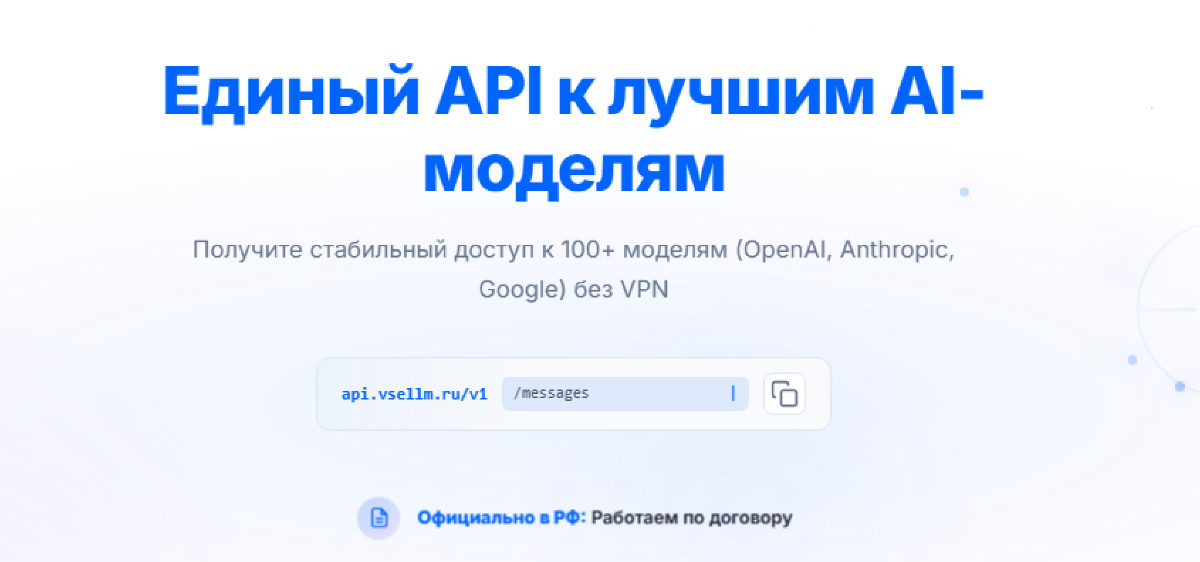
 VseLLM ▲ 3 ▼ 0
VseLLM is an infrastructure API gateway and aggregator that delivers unified access to major international AI models through an OpenAI-compatible endpoint.
 NeuroAPI ▲ 3 ▼ 0
NeuroAPI is an infrastructure API gateway designed to give engineering teams and businesses unified access to leading artificial intelligence models under a single account and balance, with billing in rubles and no need for foreign payment methods or network proxies.