 Contact for pricing
Jitera
Quick facts
- Pricing model
- Contact for pricing
- Minimum price
- Contact for pricing
- Free access
- No
- Platforms
- Web
- Interface languages
- English
- Service status
- Online, checked
Developer and reliability
Information about the developer and the service's terms. This is a factual reference, not a quality assessment or a guarantee of safety.
- Domain registered
- June 8, 2021
- The domain registration date is not the service's launch date.
Compare with alternatives
Choose a pair to compare features, pricing and payment methods.
About the tool
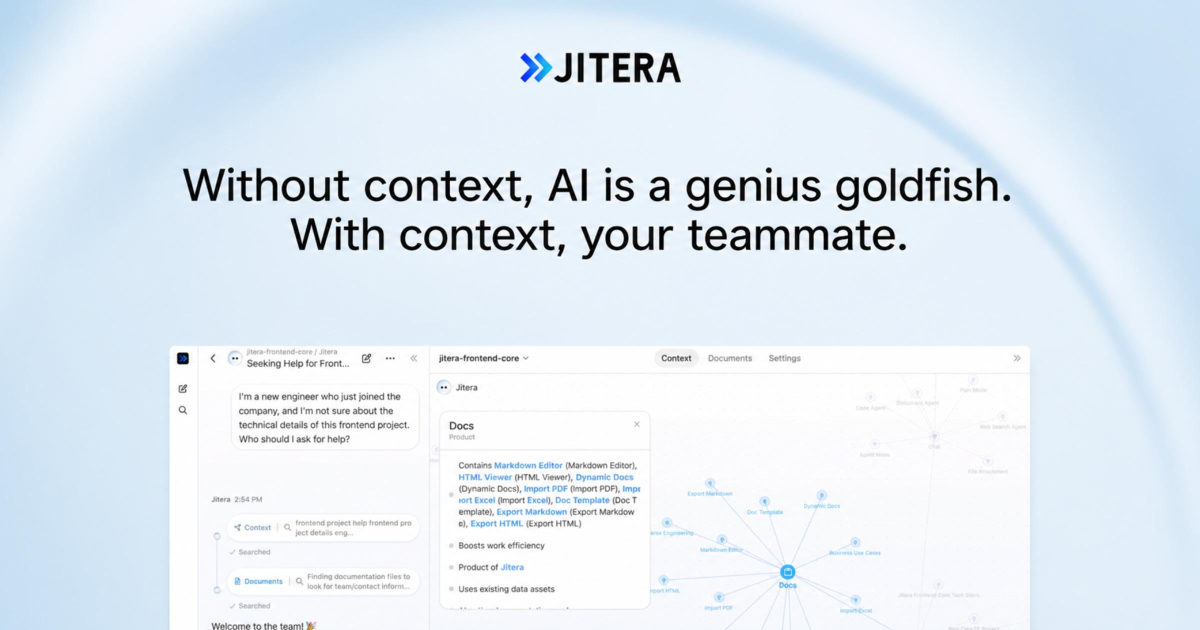
When software teams introduce artificial intelligence into their daily routines, they usually encounter a structural bottleneck: every engineer, designer, or product manager prompts an isolated model in private chats. The AI lacks the team's institutional memory, while outputs get copy-pasted across tools, leaving coworkers out of sync and generating disjointed drafts. Jitera approaches this problem from an architectural angle, transforming scattered codebases, specifications, and internal discussions into an indexed organizational knowledge layer.
At its foundation, the platform operates like a shared execution runtime for teams and autonomous agents. Instead of treating large language models as standalone text boxes, Jitera anchors them to a centralized Context Map:
- Living organizational memory: The system ingests source code from repositories, architectural documentation, and uploaded office files (.pdf, .docx, .xlsx, HTML), turning past decisions and conventions into a continuous knowledge graph.
- Multi-model agent fleet: Rather than locking operations into a single ecosystem, workspace administrators assign specific engines per agent, picking from leading providers like OpenAI, Anthropic Claude, and Google Gemini, or pointing agents to self-hosted private endpoints.
- Agent-to-agent delegation: High-level objectives are split across specialized sub-agents. One agent can parse technical constraints from a repository while another compiles API specifications or drafts verification steps.
- Human-in-the-loop controls: Before executing multi-step pipelines or altering internal documents, agents stop at decision checkpoints to confirm details with team members rather than hallucinating assumptions.
- Bi-directional collaboration: Team members interact with agents directly inside shared threads, co-edit documents in real time, or trigger routines from Slack, GitHub, Linear, and Notion.
Much like Taskade coordinates agent interactions around structured project views, Jitera connects autonomous routines directly to team workflows. However, Jitera specifically enforces strict boundaries on critical infrastructure: connected source repositories remain strictly read-only, ensuring agents analyze architecture and surface insights without making unverified direct commits to live code.
Jitera Reviews
No reviews collected yet
We are collecting user reviews of this tool from public sources. They will appear here soon.
Jitera Pricing & Plans
Prices are based on the provider's information and may change.
Looking for a free option? Try these alternatives to Jitera:
Jitera Feature Comparison
Compare key features, prices and capabilities with similar tools
| Feature |  Current tool |  |  |  |
|---|---|---|---|---|
| Pricing model | Contact for pricing | Freemium | Freemium | Freemium |
| Minimum price | Contact for pricing | from $10/month | from $12/month | from $20/month |
| Free access | No | Yes | Yes | Yes |
| User rating | ||||
| Current tool |
Frequently Asked Questions about Jitera
Which AI models can be used with Jitera?
Jitera allows workspace administrators to configure models on a per-agent basis. Teams can connect frontier model families from OpenAI, Anthropic Claude, and Google Gemini. For restricted environments, administrators can also plug in self-hosted model endpoints running on private infrastructure.
Does Jitera make direct commits to connected code repositories?
No. When connected to external version control repositories like GitHub or GitLab, Jitera operates in a read-only capacity. Agents analyze code structures, extract architecture details, and document legacy logic, but modifications are restricted to internal project documents and shared specifications.
Can Jitera run entirely inside an isolated, on-premise infrastructure?
Yes. Beyond public cloud access, Jitera supports self-hosting inside enterprise VPCs across AWS and Azure, as well as fully air-gapped on-premise deployments. In air-gapped mode, all agent traffic routes to internal private LLM endpoints without making external outbound calls.
What subscription plans and pricing structures are available?
Jitera provides tailored enterprise plans with pricing available upon request. Subscriptions are negotiated directly with the sales team based on deployment requirements, infrastructure architecture, and organizational scale.
What languages is the Jitera interface available in?
The Jitera interface is available in: English.
What platforms is Jitera available on?
Jitera is available on: Web.
Similar tools
 Taskade ▲ 2 ▼ 0
Generates fully deployed software systems, such as CRMs, client portals, and dashboards, from simple text descriptions. It combines relational databases, specialized AI agents, and automated workflows across multiple project views without touching code.
 Anara ▲ 2 ▼ 0
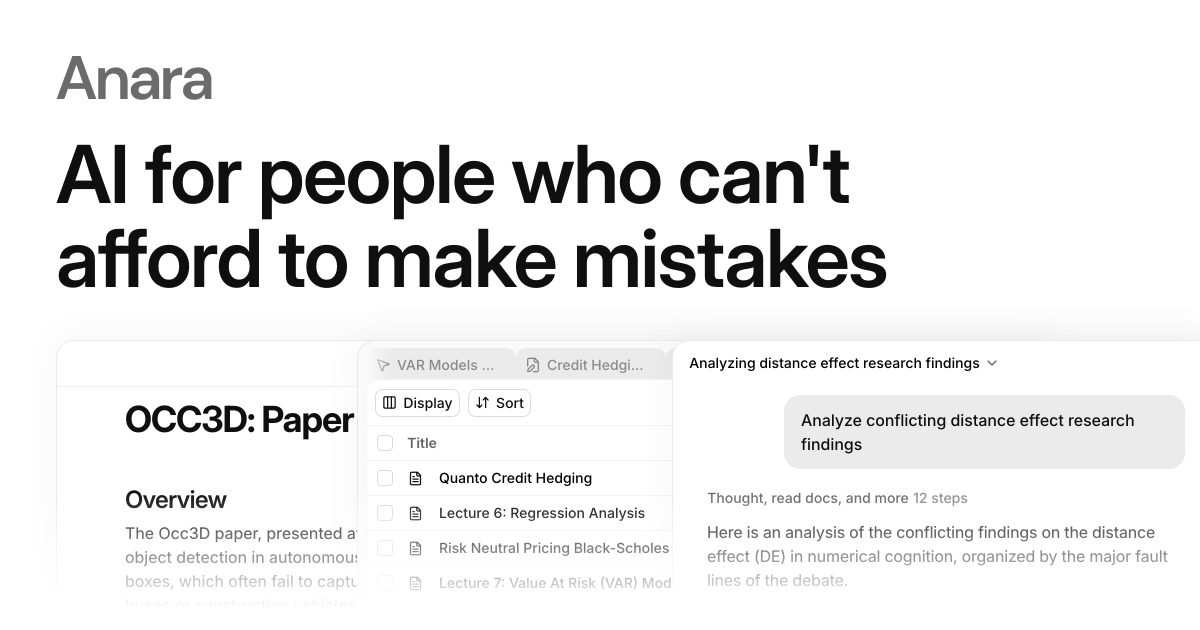
Extracts and synthesizes findings from personal document libraries and academic databases to support research workflows. Every generated answer is anchored to verified sources with clickable citations pointing directly to the exact page and paragraph.
 Replit ▲ 2 ▼ 0
Builds and deploys full-stack web applications, backends, and databases directly from natural language prompts within a unified cloud workspace. An autonomous agent generates multi-file code, installs dependencies, and runs automated browser tests to detect and fix errors.
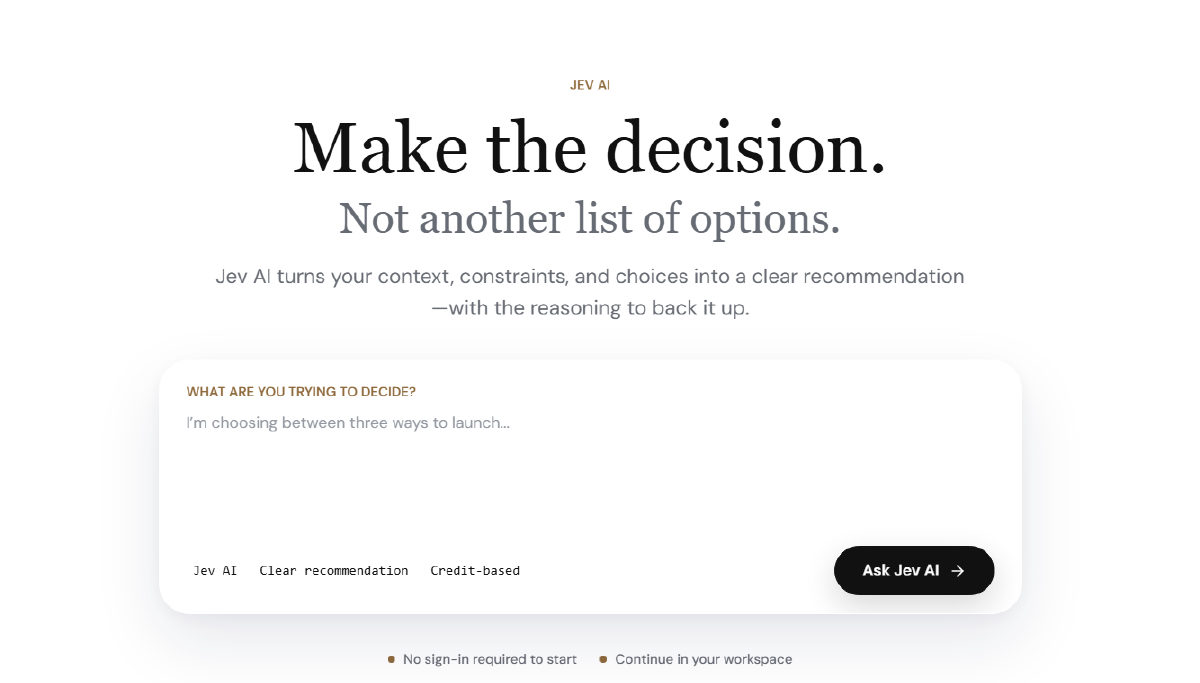
 Jev AI ▲ 1 ▼ 0
Transforms raw constraints, priorities, and project notes into structured decision trees and concrete recommendations. The platform also functions as an aggregation hub for generating and editing image, video, and audio assets under a unified credit balance.