 Free trial
Cognee
Quick facts
- Pricing model
- Free trial
- Minimum price
- Depends on the plan
- Free access
- Trial access
- Platforms & integrations
- Web
- API
- MCP Server
- IDE Plugin
- GitHub
- Service Integrations
- Claude Plugin
- Claude Code Plugin
- Cursor Plugin
- Codex Plugin
- VS Code Extension
- Hermes Plugin
- n8n
- Dify
- OpenClaw Plugin
- Cline Plugin
- Payment methods
- Visa
- Mastercard
- American Express
- JCB
- Discover
- Diners Club
- UnionPay
- Apple Pay
- Link
- Interface languages
- English
- Service status
- Online, checked


Developer and reliability
Information about the developer and the service's terms. This is a factual reference, not a quality assessment or a guarantee of safety.
- Developer
- Topoteretes UG
- Legal entity's country
- Germany
- Registration details
- Amtsgericht Charlottenburg HRB 252065B
- Domain registered
- December 21, 2023
- The domain registration date is not the service's launch date.
Compare with alternatives
Choose a pair to compare features, pricing and payment methods.
About the tool
Most AI agents still operate with the memory of a goldfish. You spin up an agent in Claude Code or Cursor, walk it through your project's architectural decisions, close the terminal, and the next day it starts from complete scratch. Standard vector databases do not fix this—they simply pull snippets based on cosine similarity, failing to register how concepts connect or the fact that an earlier decision was superseded.
Cognee tackles agent amnesia by treating memory as an interconnected system rather than a flat pile of text chunks. Created by Berlin-based Topoteretes UG, it is an open-source memory engine that integrates vector retrieval, knowledge graphs, and relational storage into one persistence layer. When you feed it documentation, repos, or chat logs, Cognee does not just chop them into pieces; it maps entities, extracts ontologies, and maintains relationships across sessions.
The entire memory lifecycle is controlled through four core operations:
- `remember`: Ingests files, repositories, or raw text, detects entities, builds knowledge graph connections, and updates vector embeddings.
- `recall`: Pulls relevant context using 14 distinct retrieval modes, ranging from keyword matching and standard chunks to graph Chain-of-Thought traversal and temporal timeline lookups.
- `improve`: Runs self-improvement cycles to reinforce frequently accessed facts, prune outdated nodes, and recalibrate edge weights based on feedback.
- `forget`: Cleanly removes individual data points, specific datasets, or an entire workspace.
While workspaces like Jitera embed a continuous knowledge graph directly into a full-cycle software development and multi-agent environment, Cognee functions as an independent, modular memory layer that connects to any setup. It provides SDKs in Python and high-performance Rust, a native Model Context Protocol (MCP) server, and plug-and-play integrations for Cursor, Claude Code, Codex, OpenClaw, Gemini CLI, Cline, VS Code, and Slack. It also slots directly into agent frameworks like LangGraph, CrewAI, n8n, and Dify, pulling live context from GitHub, Google Drive, and Notion.
Under the hood, the engine is open source under the Apache 2.0 license, allowing teams to run it self-hosted, on-premise, or in air-gapped environments without external network calls. For those who prefer a managed setup, Cognee Cloud offers hosted multi-tenant workspaces backed by an open-weight model from OpenAI.
On the flip side, keep in mind a few operational constraints: the standard workspace interface limits you to one external data connection per workspace, idle cloud instances scale to zero and take up to a minute to wake up, and full PostgreSQL graph unification remains a demo feature in the community edition compared to enterprise deployments.
Cognee Reviews
No reviews collected yet
We are collecting user reviews of this tool from public sources. They will appear here soon.
Cognee Pricing & Plans
Free credits
1 workspace
1,000,000 tokens
Dedicated Cloud
Prices are based on the provider's information and may change.
Looking for a free option? Try these alternatives to Cognee:
Cognee Feature Comparison
Compare key features, prices and capabilities with similar tools
| Feature |  Current tool |  |  |  |
|---|---|---|---|---|
| Pricing model | Free trial | Freemium | Contact for pricing | Freemium |
| Minimum price | from $5/month | from $10/month | Contact for pricing | from $20/month |
| Free access | Trial access | Yes | No | Yes |
| User rating | ||||
| Current tool |
Frequently Asked Questions about Cognee
How does Cognee differ from a regular vector database or basic RAG?
Standard vector databases only return chunks that appear mathematically close to a search query, completely ignoring the structural relationships between facts. Cognee unifies a knowledge graph, a vector index, and relational metadata. It extracts entities, links dependencies, and tracks data provenance, allowing agents to navigate complex multi-hop questions, understand chronological changes, and cite specific sources instead of guessing from disconnected text fragments.
Can I run Cognee locally without sending data to external AI APIs?
Yes. The core engine is open source under Apache 2.0 and can be deployed entirely offline or inside an air-gapped VPC with zero external connections. You can run local entity extraction and embedding routines without providing external LLM keys, or connect the system to private endpoints and locally hosted open-weight models.
Which development tools and agent frameworks work with Cognee?
Cognee features a dedicated MCP server and custom extensions that work directly with Claude Code, Cursor, Codex, OpenClaw, VS Code, Cline, and Gemini CLI. It also provides Python and Rust SDKs, a REST API, and native connectors for agent orchestrators like LangGraph, CrewAI, n8n, and Dify, as well as data integrations for Slack, GitHub, Notion, and Google Drive.
How does Cognee Cloud pricing and billing work?
Cognee Cloud uses a trial model. New accounts receive 10 free credits to test one workspace with up to 1,000,000 tokens without entering payment details. Beyond the trial, usage is billed at $1.00 per 1,000,000 tokens, and each additional workspace costs $5.00 per month. Dedicated Cloud deployments are available on custom terms. Supported payment methods include Visa, Mastercard, American Express, JCB, Discover, Diners Club, UnionPay, Apple Pay, and Link.
How can I pay for Cognee?
Cognee payment methods: Visa, Mastercard, American Express, JCB, Discover, Diners Club, UnionPay, Apple Pay, and Link.
What languages is the Cognee interface available in?
The Cognee interface is available in: English.
What platforms is Cognee available on?
Cognee is available on: Web, API, MCP Server, IDE Plugin, GitHub, Service Integrations, Claude Plugin, Claude Code Plugin, Cursor Plugin, Codex Plugin, VS Code Extension, Hermes Plugin, n8n, Dify, OpenClaw Plugin, and Cline Plugin.
Similar tools
 Taskade ▲ 2 ▼ 0
Generates fully deployed software systems, such as CRMs, client portals, and dashboards, from simple text descriptions. It combines relational databases, specialized AI agents, and automated workflows across multiple project views without touching code.
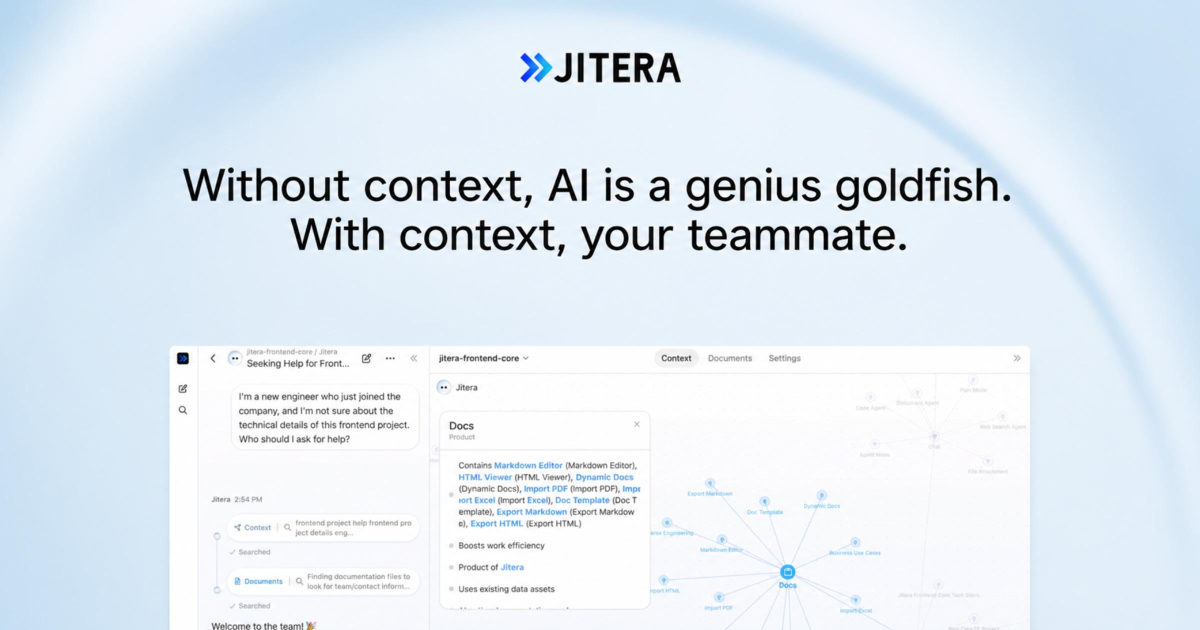 Jitera ▲ 1 ▼ 0
Provides software teams with a shared workspace where autonomous AI agents access centralized codebases, technical specifications, and project discussions. Teams can coordinate multi-model agent workflows using human-in-the-loop checkpoints and read-only repository analysis.
 Replit ▲ 2 ▼ 0
Builds and deploys full-stack web applications, backends, and databases directly from natural language prompts within a unified cloud workspace. An autonomous agent generates multi-file code, installs dependencies, and runs automated browser tests to detect and fix errors.